All flight plans belong to a site. To learn how to create a new site, visit the article Wingtra CLOUD General Overview.
Create a new flight plan
There are two options to create a new flight plan:
1. Create a new Site and select if you want to import a flight plan or create a new flight.
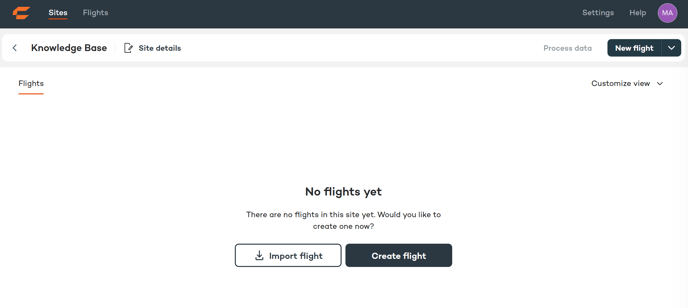
2. Go to the Flights menu and click on the New flight button on the top right

To import a flight plan, browse the location where the .flightplan file is stored and upload it.
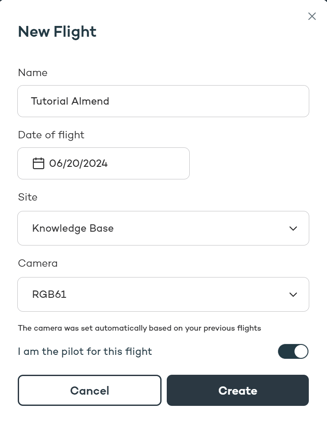
To create a new flight plan, specify the name and date of the flight, the site to which it belongs, and the camera that will be used. You can also select the pilot of the flight among the people who belong to the same organization.
Use the layers banner on the left to change between street or satellite view and to show or hide features.
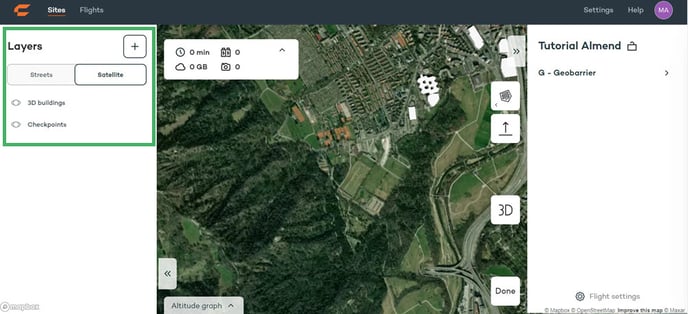
The 3D buildings and checkpoints layers are enabled by default and visible on the map. Disable them by clicking on the eye icon.
To import layer files (kml, dxf, geojson) click on the + icon and browse the location where the file is stored.
Set up the area and flight parameters
Click on the Area button to draw the area to be mapped. Then, click on the map to define the borders of the area. To finish drawing the area, click on the first node.

Then, specify the take-off and landing point by clicking on the Take off button and select the location on the map.

Click on the 2 arrows on the right side to define the take off, area and safety parameters.
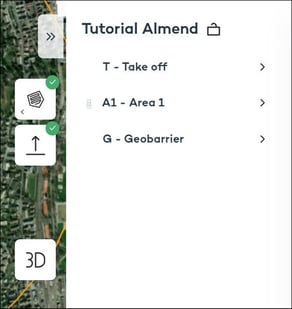
Take off parameters
Transition height: height above home that the drone transitions into forward flight.
Transition direction: direction of the loiter circle that the drone will use to loiter up to the flight height.
Area parameters
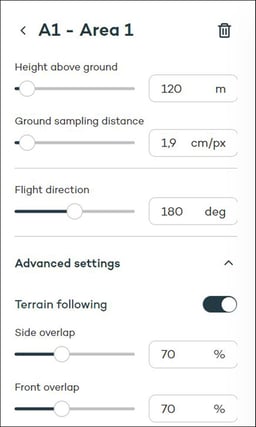
Height above ground: flight above ground that the drone will use to map the area
Ground sampling distance (GSD): size of a pixel on the ground. It is directly linked to the flight height, which you can adjust alternatively
Flight direction: direction of the sweeps
Advanced settings: Enable or disable terrain following for this flight and set the side and front overlap. Terrain following is enabled by default.
Geobarrier
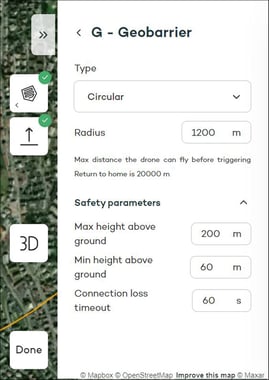
Select the type of geobarrier among circular and polygonal. The default option is the circular geobarrier, which is a circle centered around the home point, and the default radius is 1200 m.
Learn more about how to define correctly the safety parameters for your flight plan in the article Safety Parameters.
Safety assessment
The safety of the flight plan, especially in challenging terrain, can be assessed using tools such as the 3D flight plan, the altitude graph and the colorization of the flight lines according to the GSD or the height above ground.
3D view
Click on the 3D button to enable the 3D view of the terrain and the flight plan. Zoom in on the different parts of the flight plan and ensure that the flight lines are at a safe distance from objects, like buildings, and the terrain. Follow the flight plan from takeoff to landing and make sure you understand the loiter circles that the drone uses to fly to the first line and return from the last one. Ensure that in steep terrain, the flight lines are parallel to the contour lines.
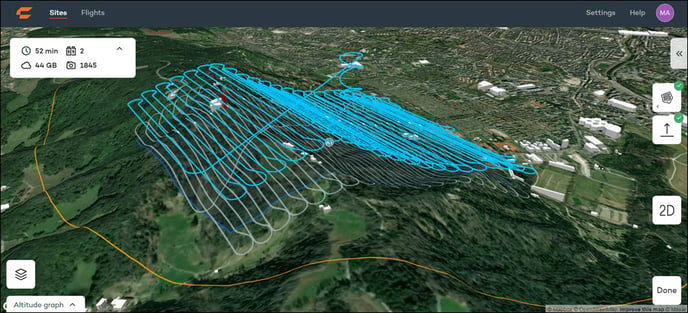
Altitude Graph
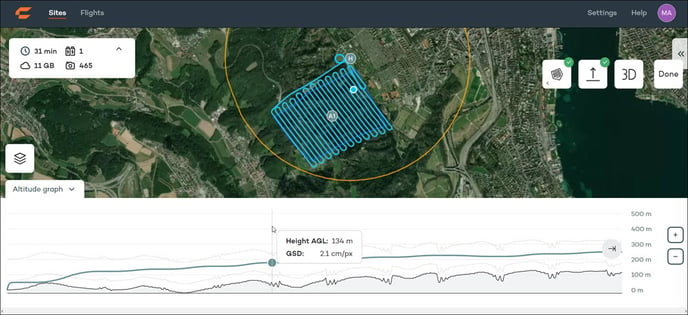
The altitude graph is located in the lower part of the screen and can be displayed by clicking on the Altitude graph button at the bottom left corner. Placing the mouse cursor at any point on the altitude graph displays the height above ground for this point and the GSD, as well as the drone's location on the flight path. This can be done in 2D and 3D view.
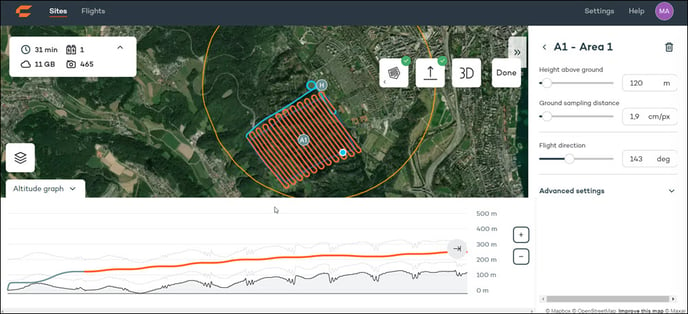
The part of the flight plan that is being modified at any moment appears in orange.
Layers
On the left side, some layers can assist in defining the flight parameters and evaluating the safety of the flight plan.
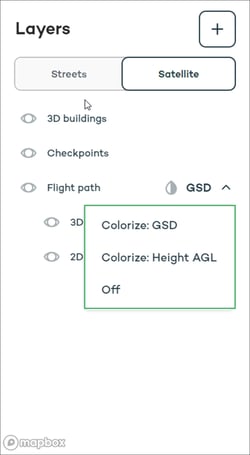
The flight path can be colorized by GSD or height above ground.
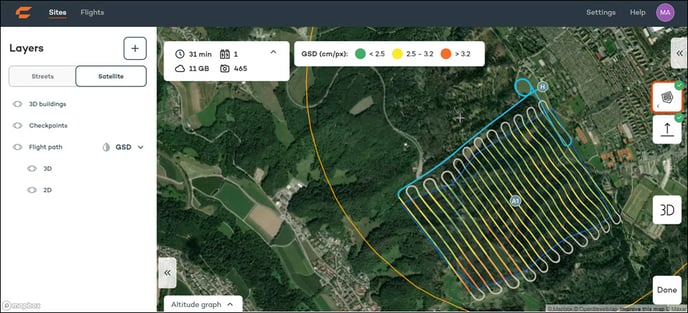
Colorizing by GSD displays the different segments of the flight path with a different color according to the GSD of the images in each segment. The clusters are created based on the defined GSD for the flight. You can view the areas where the GSD is yellow or orange, which means that the images will have a higher than specified GSD, and try to correct it by changing the flight direction or splitting the area into smaller ones.
Colorizing by height AGL displays the different segments of the flight path with a different color according to the distance to the ground. Purple parts indicate where the drone is closer to the ground than the specified minimum height above ground parameter. Pay additional attention in these parts and ensure that there are no objects and the drone does not approach too much to the ground. Blue areas indicate where the drone exceeds the maximum height above ground parameter.
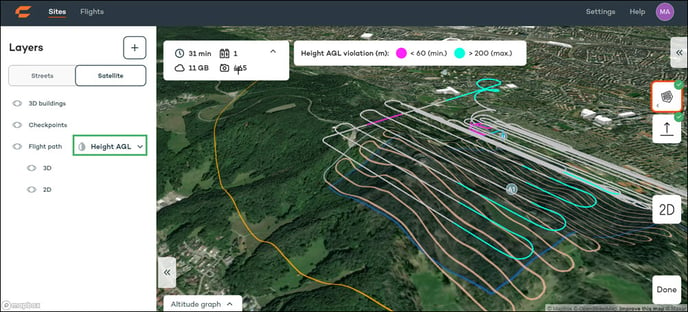
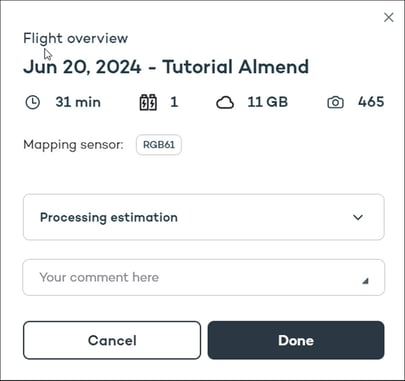
Once the flight plan is completed and checked for safety, save it by clicking on the Done button in the bottom right corner. A flight overview will be displayed containing the estimated flight time, the number of batteries needed to complete the flight, the storage space required to save the data and the estimated number of images. The estimated processing time of the map can also be seen. You can leave a comment for the pilot and click on Done to save the flight plan.